
Why Central Reservations Teams Are Slower Than Hotel Front Desks
A central reservations team usually answers slower than the property desks it serves, and it isn't because it handles more mail. Assessment data on where the gap comes from, and what closes it.


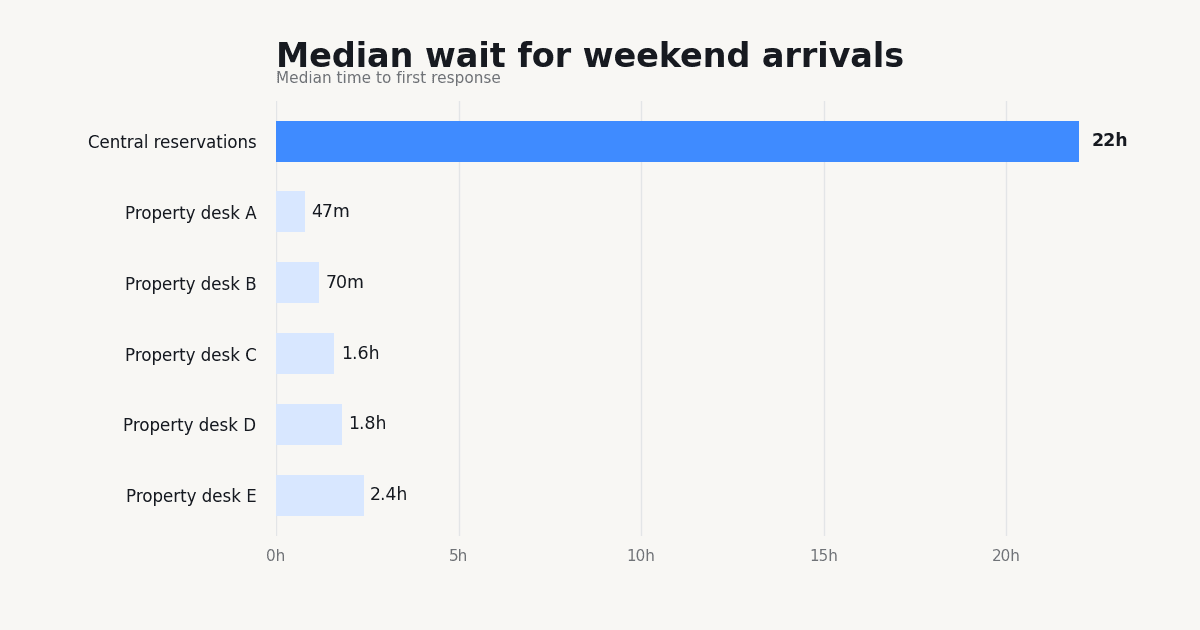
A central reservations team is usually slower than the property front desks it serves, and the reason is cover rather than workload. Central offices run office hours; guest mail arrives around the clock. In a 90-day assessment of six reservation mailboxes in one hotel group, the central mailbox answered weekend arrivals in a median of 22 hours. The fastest property desk answered them in 47 minutes.
That gap is not a staffing failure by the people in the central office. It is what happens when a chain applies a property staffing model to a mailbox that behaves nothing like a property.
What does a central reservations team actually handle?
Not the same mail as a front desk, which is the first thing that gets missed.
In the group assessed, the central mailbox carried 31% of all guest email across six mailboxes. The composition was different, though: 59% of its mail carried booking, modification, group or upsell intent, against 35% at the next-highest property desk and 40% across the group as a whole.
So the central office is not a general enquiry desk that happens to sit at head office. It is the commercial mailbox. It handles the chain-wide enquiries, the corporate requests, the group bookings, and the guests who have not yet decided which property they want.
Which makes the speed figures matter more than they would anywhere else.
| Measure | Central reservations | Fastest property desk | Group overall |
|---|---|---|---|
| Share of the group's guest mail | 31% | ||
| Booking-related share of its own mail | 59% | 35% | 40% |
| Median wait, booking-related mail | 4.6h | 38m | 2.5h |
| Median wait, all mail | 3.3h | 31m | 2.0h |
| Weekend median wait | 22h | 47m | 14h |
| After-hours median wait | 12h | 41m | |
| Replies taking longer than 12 hours | 35% | 7% | 26% |
- Share of the group's guest mailCentral reservations31%Fastest property deskGroup overall
- Booking-related share of its own mailCentral reservations59%Fastest property desk35%Group overall40%
- Median wait, booking-related mailCentral reservations4.6hFastest property desk38mGroup overall2.5h
- Median wait, all mailCentral reservations3.3hFastest property desk31mGroup overall2.0h
- Weekend median waitCentral reservations22hFastest property desk47mGroup overall14h
- After-hours median waitCentral reservations12hFastest property desk41mGroup overall
- Replies taking longer than 12 hoursCentral reservations35%Fastest property desk7%Group overall26%
Six mailboxes, 12,470 guest-initiated email threads, 90 days. Response time is elapsed clock time from the guest's first message to the first substantive reply. Medians, not averages.
Why is our central reservations team slower than our front desks?
Not because it gets more out-of-hours mail. This is the part that settles the argument.
The central mailbox had the lowest share of after-hours arrivals of all six mailboxes in the group: 29%, against 33% to 40% at the property desks. It receives proportionally less mail outside office hours than the properties do, and it answers that mail far slower, a median of 12 hours against 41 minutes at the fastest desk.
Guests behave identically across every mailbox in the group. The arrival curve is the same shape everywhere: a climb from 07:00, a plateau across the working day, a long tail into the evening. What changes between mailboxes is who was there to answer.
A property front desk is staffed at 22:00 on a Saturday because someone has to hand over a room key. A central reservations office is not, because nothing physical requires it to be. So the mailbox carrying the highest concentration of booking intent in the group is also the one with the thinnest cover on mail that arrives while guests are actually planning trips.
What does the routing question cost?
There is one behaviour that shows up in central reservations mail and almost nowhere else: asking the guest which hotel they meant before giving them anything of value.
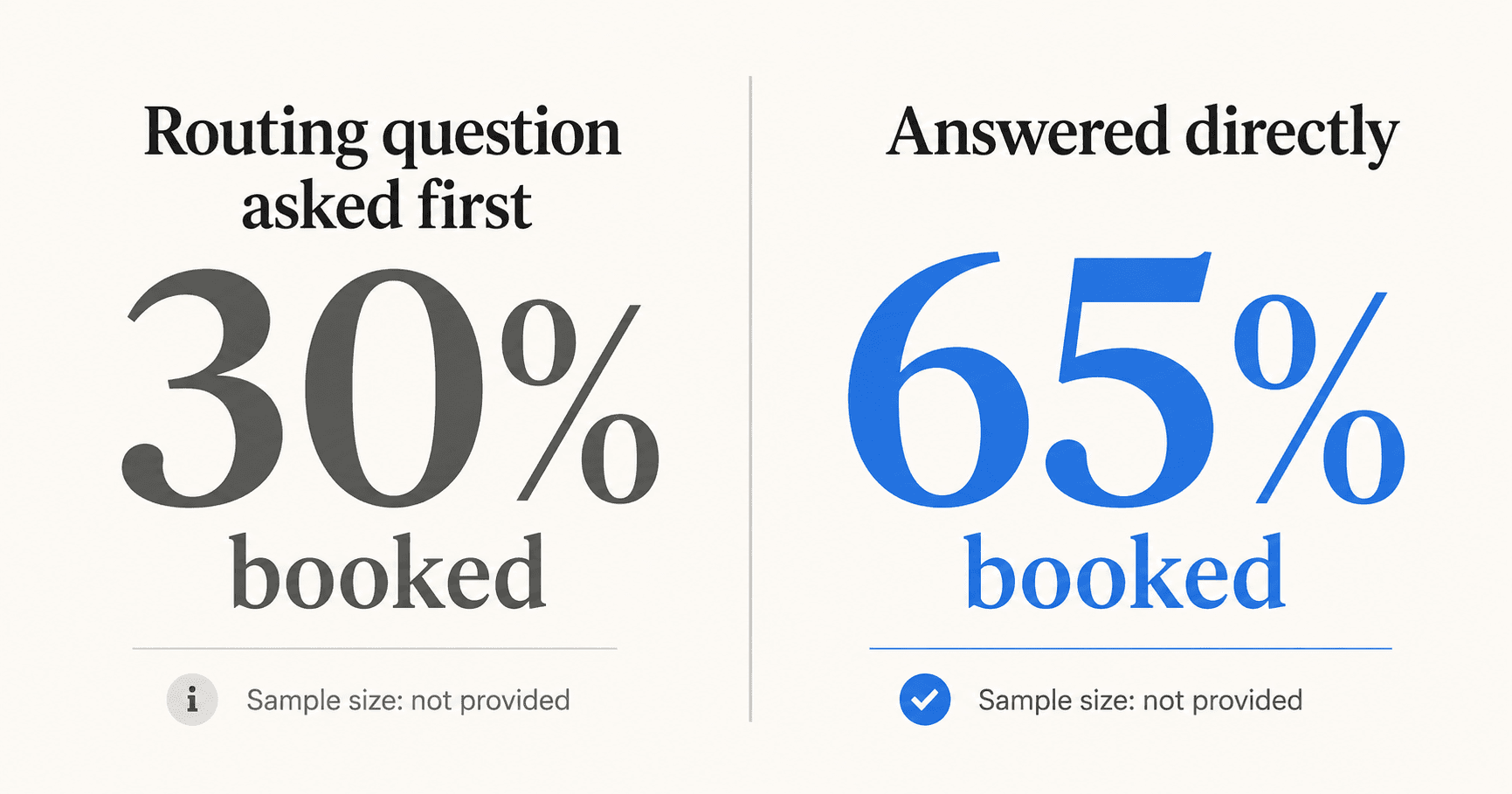
In the same assessment, threads that opened with a routing question booked at 30%. Threads answered directly booked at 65%. Roughly one in seven of the central mailbox's threads opened this way. Zero of the five property front desks did it, for the obvious reason that a guest writing to a property already knows which property they mean.
The honest caveat: guests who do not name a hotel may be earlier-stage shoppers who were always less likely to book. This data cannot separate "the extra round trip cost the booking" from "these guests were less committed to begin with."
The action is the same either way. A guest who has not named a hotel is asking to be recommended to, not interrogated. Two or three options with dates and prices costs nothing to test against the current default.
Who should own corporate enquiries in a hotel group?
Someone named, and usually nobody is.
The same assessment segmented demand by who was writing. Corporate clients booked at 77%, travel agencies at 61%, individual guests at 56%.
Corporate enquiries arrive structured, with dates, headcount and invoicing details already stated. They are the best-converting traffic in the group. They also route to the central mailbox, receive no distinct handling, have no named owner and no follow-up rule, and sit in the same queue as a guest asking about parking.
That is not a small operational detail. It is the highest-value segment in the group being treated as general enquiry volume.
How can a hotel group improve its central reservations team's response times?
Four things, in the order they pay back.
Cover the hours nobody is there. The single largest source of the gap, and it does not require night staff. What it requires is that availability questions, rate quotes and confirmations can be answered outside office hours without a person present, with everything sensitive still waiting for approval in the morning.
Answer instead of routing. When a guest has not named a property, send two or three options with dates and prices rather than a question. The current default costs an entire round trip before the guest receives anything they can act on.
Give corporate demand an owner. A named queue, a response standard, a follow-up rule. It converts at 77% and currently has none of the three.
Make the second message a rule, not a memory. In the same group, central reservations threads that reached two or more exchanges booked at 72%, against 42% at a single exchange. The second message is where the guest's real obstacle surfaces, because the first reply usually cannot know what it is yet.
How do hotel groups cover reservations email at weekends without extra staff?
By separating actions by risk rather than by hour.
Answering an availability question at 23:00 on a Saturday is low risk: the data is in the PMS, the answer is checkable, and getting it wrong costs a correction. Cancelling a booking at 23:00 on a Saturday is not. Most inbox tools treat those the same and force a choice between cover and control.
Split them, and most weekend volume can be handled without anyone working a weekend. Availability answers, rate quotes and confirmations go out; cancellations, refunds, rate changes and anything ambiguous wait for approval on Monday morning, with the draft already prepared.
One rule for the group, not six local fixes
The pattern repeats at every property desk in the group at smaller scale, and every desk shows the same lift from a second exchange. That is the argument for setting response standards, follow-up rules and out-of-hours handling centrally and applying them per property, rather than asking six teams to each solve it locally and hoping the results converge.
Altek is guest communication software for hotels, specifically an AI inquiry conversion engine that does the work behind each reply. It reads each inquiry, retrieves live availability and rates from the PMS, prepares the reply and the reservation work behind it, and follows up when a thread goes quiet, with human approval on every action.
If you want your own version of the numbers in this article, an inbox assessment reads 90 days of your actual mail and shows your central team against your own property desks before you decide anything.
About Altek
Altek handles hotel email end to end. It reads each guest inquiry, retrieves live availability and reservation data from the hotel's PMS, writes the reply and carries out the work behind it: reservations, modifications, restaurant and spa bookings and payment links, with human approval on every action. Altek works with Mews, Opera Cloud and Visbook/BookVisit, and is used by more than 100 hotels across eight countries. Founded in Norway, headquartered in Oslo.